Last week, I joined student and administrative staff in welcoming the new class of students to the Democracy Lab Residential Learning Community. It was a great start to the year, and we’re excited for what’s ahead.

I have a new working paper out, with Lucas Núñez (George Mason) and Brett Burkhardt (Oregon State): Incarceration and Deservingness: Experimental Evidence on Less Eligibility.

The paper pairs old political theory with new experimental data: we take Bentham’s centuries-old principle of “less eligibility” — that no one subject to punishment should be better off than the poorest free person — and test it directly with a pre-registered survey experiment on nearly 2,000 U.S. adults. We find that Americans are significantly less willing to support the very same government program (a year of free college courses and job counseling) for an incarcerated applicant than for an equally poor applicant who’s never been incarcerated. That penalty barely budges even when the incarcerated applicant is shown to benefit more from the program, and it actually widens when he’s described as hard-working. The takeaway: resistance to prison programming looks less like a gap in information than a durable moral judgment about who counts as deserving, rooted in an idea political theorists have been arguing about since the eighteenth century.

I’ve posted the pre-print to SSRN.

Later this month I’ll be presenting at the Law and Society Association’s annual meeting in San Francisco. My panel is titled ‘Hierarchies and Identities in Law.’

The Center for Humanities Research built a wonderful scholarly community at Mason. Thursday’s farewell was bittersweet — seeing familiar faces was lovely, but losing the CHR is a significant loss for the University.

I’ll be presenting at the Western Political Science Association annual meeting in San Diego in a few weeks. The paper, “Development as Justification: Nature, Socialization, and Early Juvenile Justice,” draws on historical research for my book-in-progress, At Risk. The talk is part of a panel titled “Care and Alienation,” scheduled for Friday, April 3, 10:00–11:45 AM.

Earlier this week, the first group of students in my Politics of Prisons class visited the Fairfax Juvenile and Domestic Relations Court. They observed court proceedings firsthand and then engaged in a lively, wide-ranging Q&A with Judge Petit.

[Updated 2026-02-20] On a follow-up visit, a second group of students watched a trial and then met with Judge Nadaraja to discuss court procedure, the responsibilities of judging, and life on the bench.

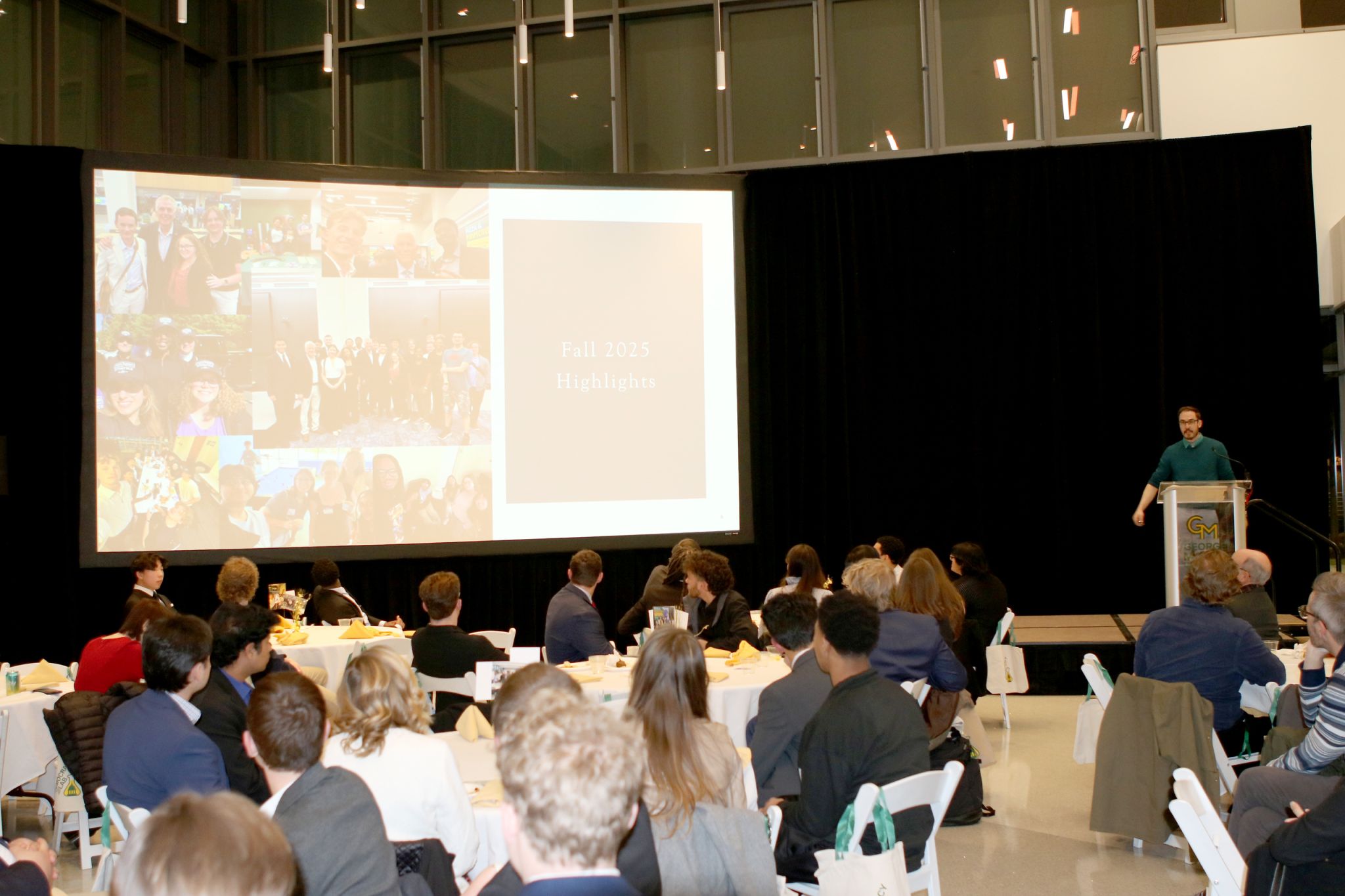
On January 23, Assistant Director of Student Engagement Emilee Duffy and I welcomed First-Year Democracy Lab students back for our annual Welcome Back Dinner—a chance to pause, reconnect, and take stock of what this learning community has already built together.

Over dinner, students, faculty, and staff shared conversation and reflected on a semester shaped by shared courses, events, and projects. One highlight of the evening was a series of fast-paced “Ignite Talks,” where Profs. Philip Martin, Kelly Richter, Lucas Núñez, Catherine Maclean, and Meghan Garrity each took on the challenge of presenting their research in just five minutes, using 20 automatically advancing slides. The format is demanding, lively, and always a student favorite. And this year was no exception.

As my first year serving as director of the Democracy Lab, the evening felt especially meaningful. The dinner captured what makes the program work: intellectual curiosity, generosity across roles, and a strong sense of community that extends beyond the classroom. I’m excited to see where the rest of the year takes us.

For more information, see Emilee Duffy’s LinkedIn post here.

Later this week I’ll be moderating a roundtable and presenting a paper at the annual meeting of the Law & Society Association. The theme of the roundtable is “The Reproduction of Legal Order” and includes a number of talented early-career political theorists. The panel is titled “Analyzing Change Across the Penal Field” and I’ll be presenting an article related to my current book project. June 6-7.

Next week I’ll be giving a talk at the Center for Humanities Research as a part of my fellowship. Details are available at this link.

In June I’ll be facilitating a roundtable at the Law and Society Association’s annual meeting on “the reproduction of legal order.” Participants include Ainsley LeSure (Brown), Yuna Blajer de la Garza (Loyola), Anna Daily (Sacramento), Kathryn Heard (Dickinson), and Marcus Board Jr. (Howard). June 6-9 in Denver, Colorado.